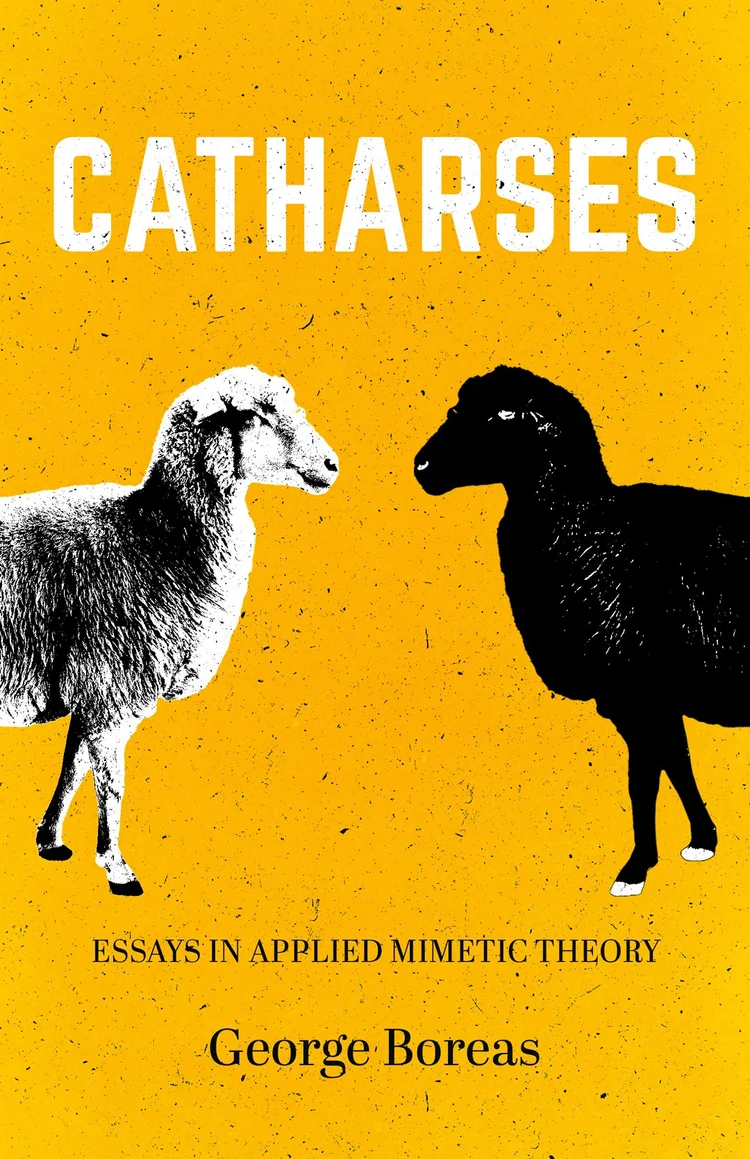
George Boreas · Applied mimetic theory
Catharses
Essays in Applied Mimetic Theory
This collection of twenty-three essays brings into one volume two years of studying, researching, and writing on René Girard’s mimetic theory. The author applies the theory to popular questions to reveal the hidden but fundamental role of mimesis in our lives and to give the reader new and empowering perspectives. The aim is to reproduce the catharsis that Girard’s own work provided to so many of his readers: expulsion of the ignorance of imitation in our desires, origins, and culture.
Girard’s rigorous theories are brought to bear upon current and popular topics in the spirit of affirming and building upon his legacy. Each essay was written to stand alone and be accessible even to readers with minimal familiarity with Girard’s work. Yet, each ventures unique analyses and many offer original takes on new questions.
Choose an edition
Five subject areas
- Philosophy
- History
- Sociology
- Politics
- Psychology
Read an excerpt
From the preface
Up until my mid-twenties, I had read a big part of the canon of Great Western Literature, and then I got bored of it all and lost interest. I had also always read non-fiction on history, science, philosophy, and theology. Over the years, I became a very qualified amateur in these subjects. So when I first opened that first book by Girard, it spoke to many of my interests. Right away I got that strange, magnetic feeling you get when you encounter the right book: I felt it was answering questions that had weighed on me for years, yet at the same time it seemed to be articulating answers that I already knew but could not articulate myself.
That first book, for example, made me remember and rethink my readings of Stendhal, Dostoevsky, and other big authors. Why, I asked myself, had I been so fascinated with those classics? What did nineteenth-century literature have to teach me about my life now in the twenty-first? Some of those books I was assigned in my high school English class, but then I went and read many more. Truth be told, a big part of the reason I read them was snobbishness – I wanted to be smart. But part of it went beyond that, part of it was genuine passion and genuine revelation. Girard’s interpretation of this literature revealed the nature of that revelation. It explained that it was the revelation of the romantic lie – the mistaken conviction that our desires are authentic and innocent. It also showed me how I was reading the books wrong. It showed how blind I was to miss the obsession with others in almost all of Dostoevsky’s main characters. And yet, I wasn’t any blinder that the consensus of literary criticism.