George Boreas · Politics and culture
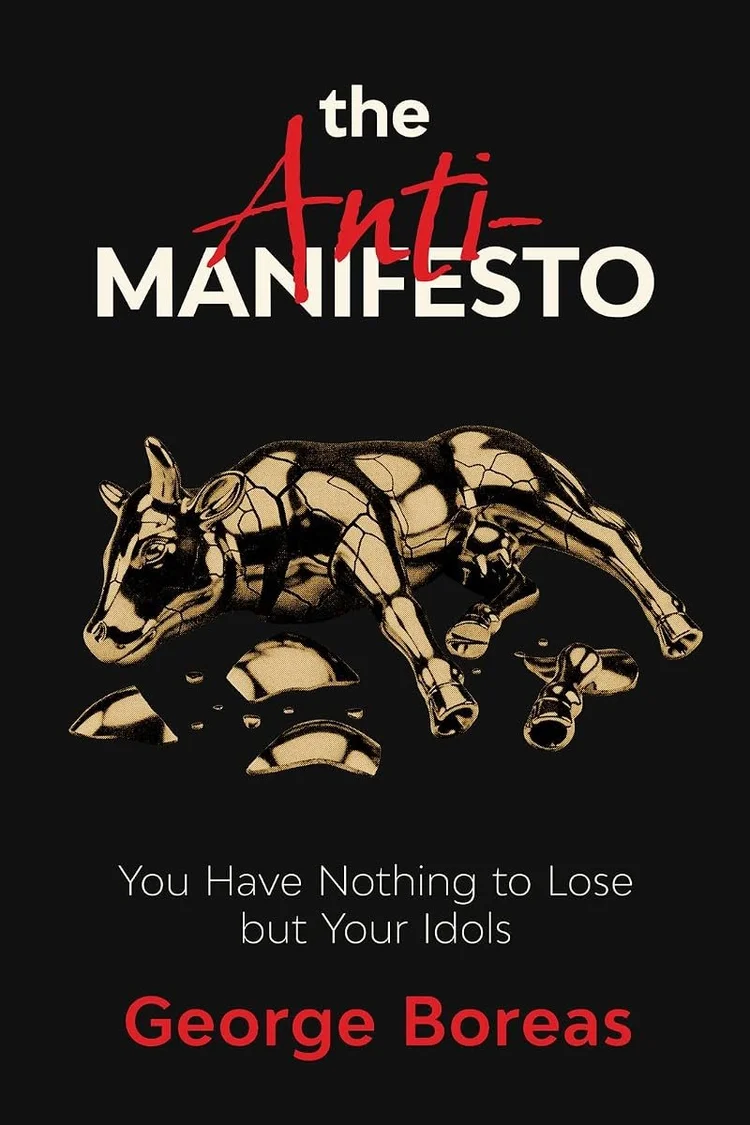
The Anti-Manifesto
You Have Nothing to Lose but Your Idols
Thus, I thought of the idea of the anti-manifesto, a declaration against every fetishization of any form of capital and against the violence this entails, and for a return to the true understanding that enables detachment from capital and mastery of it employed for constructive and gracious ends. René Girard’s mimetic theory provides a powerful analytical framework for such a manifesto, but the wisdom of it is ultimately the wisdom of Christianity, the true religion that from the beginning taught us the dangers of worldly obsessions and, in the final analysis, of idolatry.
Choose an edition
Contents
- The Communist Manifesto as Hypnotic Spell
- Marx’s Materialist Fetish
- Knights and Kapitalists
- Das Kapital Mistake
- The Anti-Manifesto
Read an excerpt
From I. The Communist Manifesto as Hypnotic Spell
Now, let me get into the mimetics of The Communist Manifesto. Mimetic anthropology, as Christian as it is, has always held out the promise of analytical deconstruction of evil spells.
The first thing to establish is what The Communist Manifesto is not. It does not discover nor begin what it calls the class struggle, not even its modern version. Nor does it give birth to the broader movement of socialism, which in the 19th century came in different strands, all united, however, in their concern for social justice, in their fight against the exploitation of workers by the new specter of industrial capitalism, and in their aim to establish new political systems with equitable participation of citizens. Class struggle and socialism as such already dominated politics across Europe in the wake of the French Revolution and throughout the first half of the 19th century.
The communists of that period had gradually distinguished themselves from broader socialists with their radicalism and calls for violent insurrection. As such, they were outlawed and forced to organize into secret societies. One such society was the Communist League, founded in 1836 in Paris by a handful of disgruntled German tradesmen (a shoemaker, a watchmaker, and a typesetter, prominent among others). They were the ones who commissioned the writing of the manifesto from Marx and Engels. Thus, the two writers were hired to express and magnify the voice of spirits that were already lurking widely across a continent in turmoil.
From all this, we can say that the manifesto’s novelty cannot lie in its social theory or even its political strategy. Rather, it lies precisely in its hypnotic power. The text is optimized to capture the attention of mass readership and focus it on one point, looking at which repeatedly and for prolonged periods of time breaks psychological resistance, induces the desired psychological state, and from there compels the subject to active obedience.